
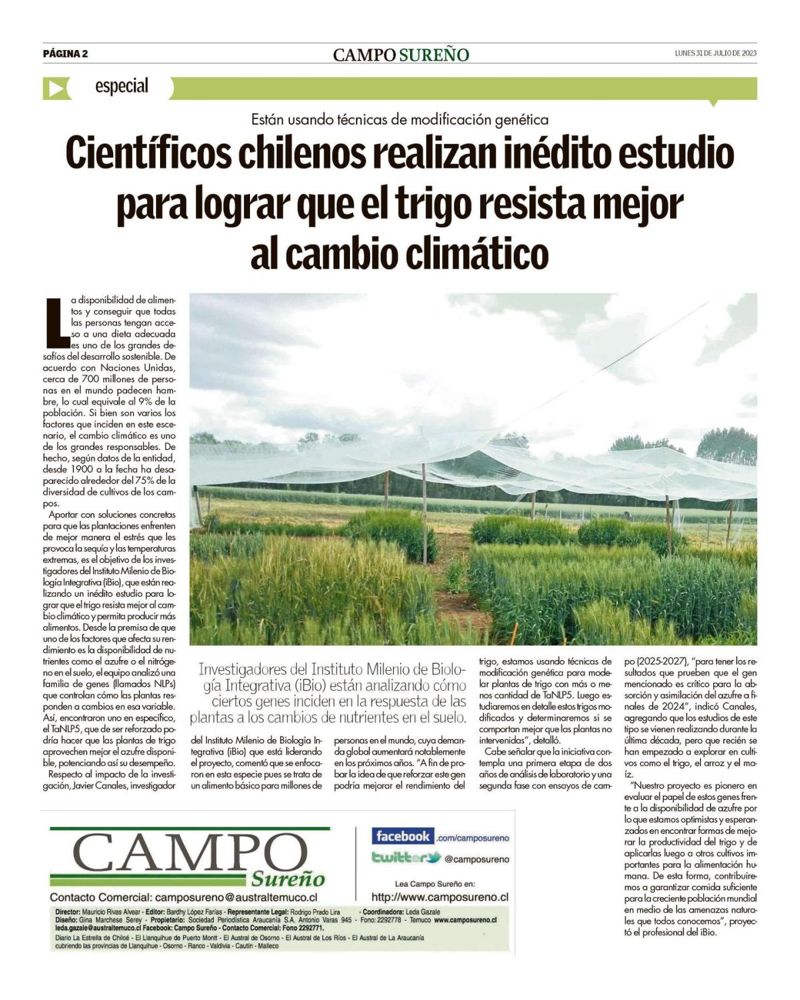
Today in the magazine #camposureño, an important highlight shines upon a research project we are conducting in our laboratory, led by Dr. Javier Canales. The aim of this research is to create wheat varieties that are more tolerant and resilient to current climate change conditions. Our team’s work is based on collaboration and from the southern regions of Chile, we are generating frontier science! 🌾🧬👩🔬👨🔬
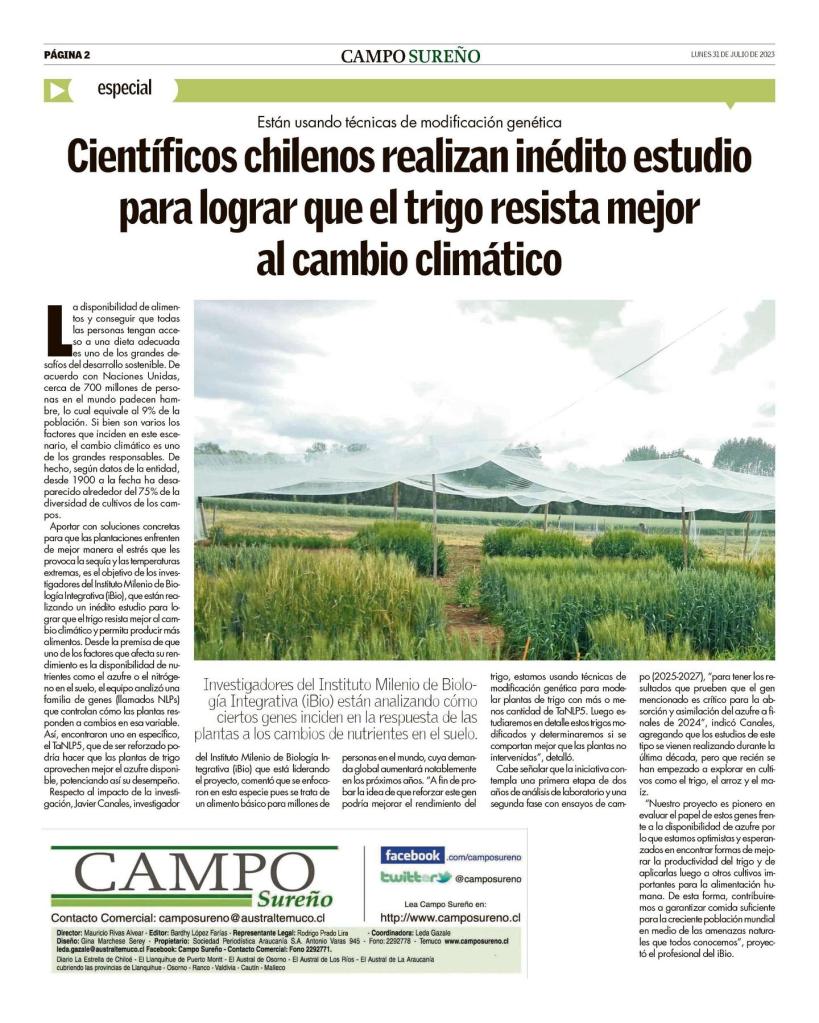
Chilean Scientists Embark on a Groundbreaking Study for Climate-Resilient Wheat
The researchers of the Instituto Milenio de Biología Integrativa (iBio) are exploring how specific genes impact the way plants respond to changes in soil nutrients.
Food availability and ensuring access to adequate diets for everyone is one of the substantial challenges of sustainable development. According to the United Nations, around 700 million people, or 9% of the global population, suffer from hunger. Climate change plays a significant role in this scenario, and since 1900, about 75% of crop diversity has vanished from fields.
Finding Solutions to Climate-Induced Stress on Crops
The scientists at iBio are working on an unprecedented study to enhance wheat’s resistance to climate change and increase food production. Recognizing that factors like the availability of nutrients such as sulfur or nitrogen in the soil affect wheat yield, the team examined a family of genes called NLPs, which control how plants respond to these changes.
Specifically, they discovered a particular gene, TaNLP5, that if strengthened, could enable wheat plants to better utilize available sulfur, thereby boosting performance.
Dr. Javier Canales, who is leading the project, focused on wheat as it is a staple food for millions worldwide, with increasing global demand. To test the idea that reinforcing this gene could improve wheat yield, the team is using genetic modification techniques to model wheat plants with varying amounts of TaNLP5. «We will then study these modified wheats in detail and determine if they perform better than the unaltered plants,» he explained.
Project Timeline and Expectations
The project involves a two-year laboratory analysis phase followed by field trials (2025-2027) to have conclusive results by the end of 2024. Studies of this kind have been conducted for the last decade, but only recently have they begun to be explored in crops like wheat, rice, and corn.
«Our project is pioneering in assessing these genes against sulfur availability, so we are optimistic and hopeful to find ways to enhance wheat productivity and apply them to other significant human food crops. In this way, we will contribute to ensuring enough food for the growing world population amidst the natural threats we all know,» projected the professional at iBio.
Conclusion
The new FONDECYT project spearheaded by our lab represents an innovative step forward in the fight against climate change’s impact on food security. By exploring novel genetic avenues, we are optimistic that our research will pave the way for more resilient wheat varieties and potentially other crops, providing tangible solutions for a world grappling with complex environmental challenges.
Stay tuned for further updates on this pioneering project that promises to reshape the way we understand and approach agricultural science, ensuring a more sustainable future for all. 🌾🧬👩🔬👨🔬


Deja una respuesta